
Read Grand Traverse County Deed Records
The Register of Deeds keeps Grand Traverse County deed records at 400 Boardman Avenue. Suite 100 places the office in Traverse City. Deeds, mortgages, land contracts, liens, easements, rights-of-way, covenants, and plats all pass through this office. The public counter welcomes visitors Monday through Friday, 8:00 a.m. to 4:00 p.m. Anyone researching a parcel number can work directly from those recorded instruments. Anyone tracing an owner of record can do the same during regular business hours.
| Deed Type | What It Does | Common Use |
|---|---|---|
| Warranty deed | Conveys land with stated covenants | Ordinary sale |
| Quitclaim deed | Conveys the interest the grantor has | Family or title cleanup |
| Fiduciary or estate deed | Transfers through an authorized representative | Estate or trust administration |
| Land contract | Records an installment land arrangement | Seller financing |
| Tax deed | Documents a tax-process conveyance | Delinquent-tax property |
A deed actually conveys an interest in land. A mortgage, lien, assignment, or discharge usually just affects an encumbrance instead. Read the deed records for the parcel together so the recorded history makes sense, rather than assuming every indexed document marks a transfer of ownership.
Search the Free Party Index First
Start with the free county document search, which offers basic index information without images. You can query by grantor or grantee, date range, and document type, and a document number or a Liber/Page reference will narrow results fast. Enter the name exactly as recorded. Then try initials, spelling variants, and a last-name-only pass if the first attempts miss.
| Index field | Best use | Local search note |
|---|---|---|
| Grantor / grantee | Find transfers by party | Try trust and company variants |
| Document type | Separate deeds, liens, mortgages | Pair assignments with discharges |
| Date | Limit an ownership era | Allow for next-working-day indexing |
| Liber/Page | Retrieve a known reference | Use zero-filled form such as 0395-0145 |
May 1966 Is the Practical Online Image Cutoff
The computerized image index reaches back to May 1966. For paid remote images, Tapestry fills that role. Deed and Liber/Page material dating to 1853 remains available through office and archival channels. Imaging and back-indexing continue, so a missing online image does not mean the deed never existed.
The Archives of Michigan holds Grand Traverse County deeds from 1853 through 1889, plus a deed index covering 1853 to 1901. Contact the Register first with the legal description and Liber/Page, then turn to the archive guide for older gaps in the property records.
Free Index Versus Paid Document Image
Grand Traverse County's search and payment guidance spells out the gap between free index access and paid document images.
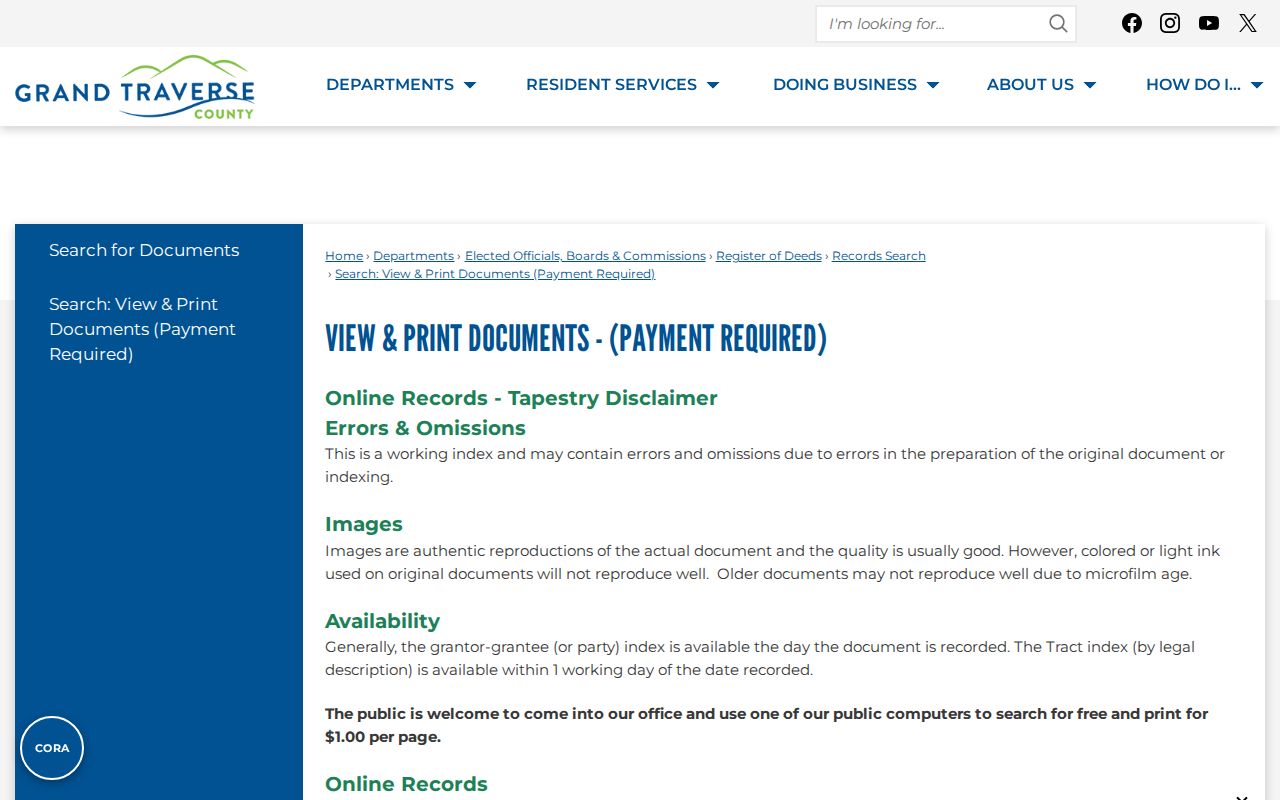
A name search costs $8.75, and each printed page adds $1. The county places a temporary $30 hold on credit-card payments. Skip the fees by using the free search computers at the office instead.
Follow the Grand Traverse Grantor-Grantee Chain
Rebuild a chain of title one party at a time. At each step, check that the legal description or parcel details match, since a name search can pull in unrelated buyers, trusts, and entities that share nothing with your property.
- Find the current owner's acquisition deed with that owner as grantee.
- Read the prior owner as grantor and note the legal description and Liber/Page.
- Search that grantor as an earlier grantee and repeat the match.
- At the online cutoff, continue through office records, microfilm, deed books, or Archives of Michigan.
- Grantor
- The party conveying an interest.
- Grantee
- The party receiving it.
- Chain of title
- The connected sequence of recorded conveyances.
- Liber/Page or instrument number
- The retrieval reference assigned to a recorded document.
Grand Traverse Deed Copy and Recording Charges
Basic copy work at the Grand Traverse County Register of Deeds runs $1 per page. Certification adds $5 to that. Anyone mailing a request should include a self-addressed stamped envelope. The alternative is paying $3 for postage and handling. County guidance sets recording at $30 for a deed, mortgage, lis pendens, certified copy, or other instrument. That fee holds no matter the page count. Assignments and discharges carry an extra $3 per additional instrument.
Tax certification costs $5 per deed. That covers up to 25 parcels, with 20 cents for each parcel beyond that. Transfer tax may also apply when the consideration is not exempt. Confirm a current total with the Register before filing.
A Free Alert Watches New Recorded Activity
Grand Traverse County runs a free Property Fraud Alert service, and enrollment is available by calling 800-728-3858. The system notifies an enrolled person when new activity posts against a name in the property records, though it cannot stop fraud, void a deed, or protect title on its own.
Obtain a Grand Traverse County Deed Copy
Copies of a Grand Traverse County deed come several ways. Tapestry delivers a recorded image remotely. The public terminal in the office allows a free search on site. A mail request works too, provided it includes the document reference. Certification costs extra effort. Request it only when the receiving party demands it. For anything recorded before 1966, include the Liber/Page reference along with party names so staff can trace the older instrument.
Recorded, not guaranteed. Grand Traverse County deed records show instruments accepted for recording. They do not resolve every unrecorded interest, priority question, boundary issue, or defect and are not a title opinion.
Use Legal Descriptions When Parcel Numbers Change
Parcel numbers are not permanent. An APN is simply an assessment label. The county may reissue it after a parcel split or combination. The deed's legal description holds up better over time. Lot-and-block calls, township-range-section references, plat details, easements, and road-right-of-way exceptions tie the same land together across decades of property records. Consult parcel maps for orientation only; the recorded instrument itself remains the authoritative source.
Read Mortgages, Assignments, Discharges, and Liens Together
Deed records tell only part of the story at the Register of Deeds. A mortgage creates a secured interest. An assignment can move that interest to a new holder. A discharge records its eventual release. Mechanic's liens and tax liens may cloud a title. Lis pendens filings, restrictive covenants, easements, and rights-of-way may also appear. All of these can sit alongside the conveyance history in the same index.
An old mortgage still sitting in the index is not automatically active. Search forward through the property records for assignments, satisfactions, modifications, and discharges. Match party name variants and the legal description as you go. A lis pendens works the same way. It signals pending litigation touching real property, not that the claimant won. Pull the civil docket and confirm with the final judgment or a recorded release.
The County Clerk holds 13th Circuit case files and public terminals at 280 Washington Street. Civil records online run from 1986 forward, with 1967 through 1985 available as index-only. Updates post nightly, so a same-day filing may lag behind.
Continue Grand Traverse Deeds Back to 1853
The online images stop well before local land records begin. Archives of Michigan holds Grand Traverse County deeds from 1853 through 1889. It also keeps deed indexes from 1853 through 1901, mortgage indexes from 1853 through 1900, and lis pendens from 1861 through 1904. Those archival groups can carry a parcel chain back behind the computerized era. Property records that old reward patience.
Work backward from the newest reliable Liber/Page citation, one transfer at a time. Before traveling to Lansing, request a narrow book, page, party, and date range. The archive also keeps historic tax rolls and rural property inventories. Those supporting records help, but they are not substitutes for a conveyance.
Ignore the courthouse-fire rumor. Kingsley's 1894 and 1900 fires are town history. They are not evidence that any decade of county deed records was lost. No official account supports that story. A missing image calls for a check with the office and the archive. It is no reason for a dramatic conclusion.
Review Every Instrument Before Extending the Chain
An index row is only a finding aid. Open the instrument itself. Confirm the recording date, the parties, marital or representative capacity, consideration language, the legal description, exceptions, signatures, and the acknowledgment. A surname that matches but land that does not is not a chain link. The reverse happens too. A deed may use an entity, trust, estate, maiden name, or initials that differ from the current tax roll, so the parcel number and description carry more weight than a name alone.
Grand Traverse County accepts letter-prefixed references such as 2012R-12345 alongside conventional Liber/Page citations. Preserve the exact reference shown. For older work, a zero-filled citation like 0395-0145 helps staff pull the right image. Microfilm can be rough. When it is, compare the index, adjoining pages, and later deed records that repeat the same description.
Recording requirements offer clues of their own. Names appear beneath signatures. Instruments use black or dark-blue ink, and county guidance cites MCL 565.48 when a death certificate must accompany a grantor described as survivor of another person. Tax certification belongs to the deed and land-contract workflow. These filing rules explain attachments. They do not settle the quality of title.
Ordering by mail is straightforward. State whether a plain or certified copy is required, and include the document reference, party names, and return handling. At the office, search is free and prints run $1 per page. Remote Tapestry searching is fast. Repeated name searches there get expensive, though, so narrowing the index first saves money.
Finish by searching forward from each instrument. A later corrective deed, discharge, assignment, easement release, judgment, or new conveyance can change the apparent result. Grand Traverse County deed records preserve whatever was submitted and accepted for recording. Only a complete examination shows how those documents relate.
Distinguish Recording from Legal Effect
The Register reviews instruments for statutory recording requirements, not for every underlying ownership dispute. A document can be recorded while questions about capacity, priority, fraud, interpretation, or an unrecorded interest still stand. So read the full instrument and its chain. A recording stamp is not a title guarantee.
For consequential work, compare the deed with court judgments, probate authority, lien releases, surveys, and later corrective instruments as applicable. A title professional or Michigan attorney can weigh those relationships. The county property records index is indispensable evidence of the public record. But its job is retrieval, not legal opinion.
Note: Phrase negative findings carefully, and state only that no matching entry appeared under the names, dates, and document types searched.
Do not claim that no deed or interest exists. Retry initials, prior names, entity variants, and the legal description. Then ask Register staff about older or incompletely imaged material. Grand Traverse County property records often hold more than the first search shows.