
Read Grand Traverse County Property Tax Records
Every Grand Traverse County parcel card ties assessment, State Equalized Value, taxable value, PRE percentage, property class, and the summer and winter tax history into one view. The labels matter as much as the totals. The listed jurisdiction collects current taxes. Your city, township, or village handles the current-year bill, while anything delinquent after March 1 moves to the Grand Traverse County Treasurer.
| Field | What It Shows | Where |
|---|---|---|
| Assessment / SEV | Dated equalized valuation | Parcel card and local assessor |
| Taxable value | Proposal A tax-base measure | Parcel card |
| PRE | Principal Residence Exemption percentage | Roll and local assessor |
| Summer / winter tax | Amounts by displayed year | Parcel card and local collector |
| Delinquent status | County-held balance after transfer | County Treasurer / BS&A |
Michigan equalization targets half of true cash value. Taxable value often sits far below that. The Proposal A cap holds taxable value down until a transfer of ownership, so no figure on the card guarantees a sale price.
The 2026 Card Separates SEV from Taxable Value
The county's published sample parcel shows the gap plainly, reporting assessment and SEV of $317,600 beside a taxable value of just $80,952. One parcel, two very different numbers.
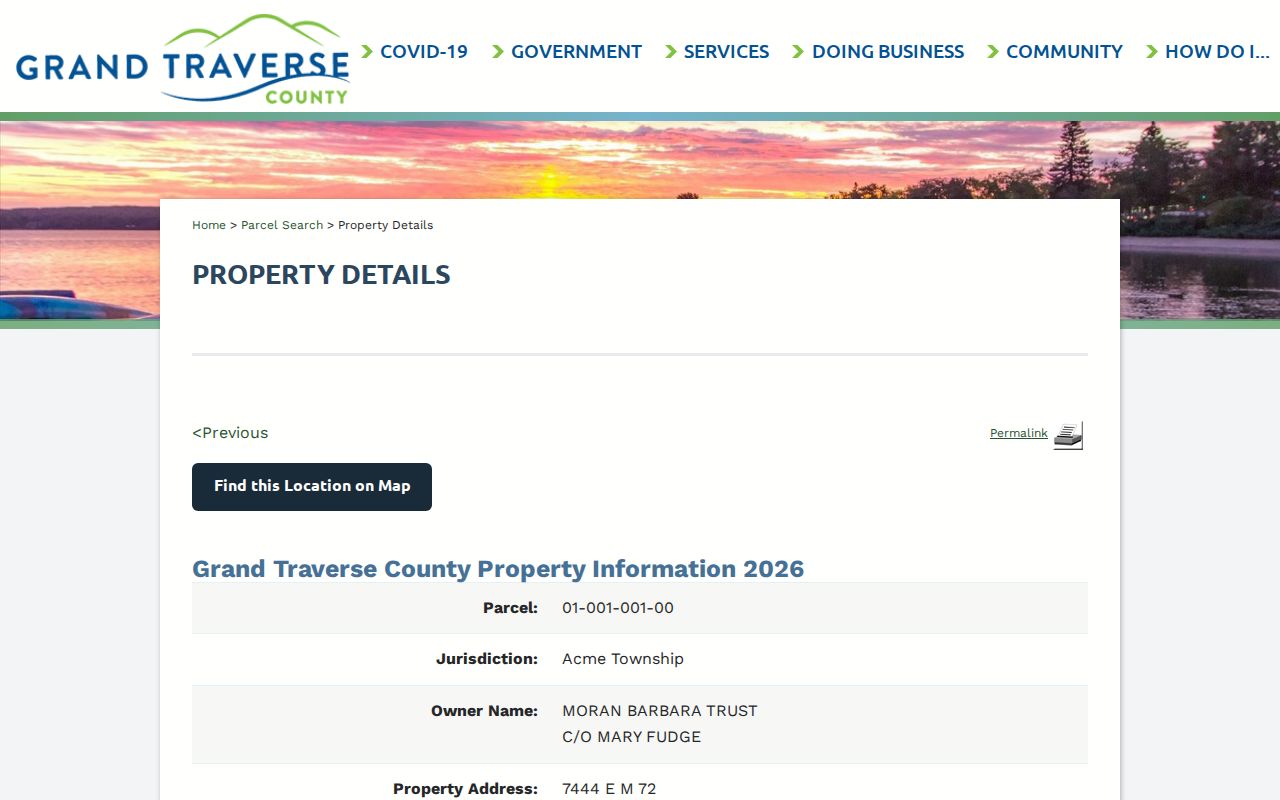
The same card lists summer and winter amounts for 2023 through 2025, with PRE shown at 0%. Dated rows invite comparison, not a market-price guess.
Current and Delinquent Taxes Follow Different Routes
For current-year property tax in Grand Traverse County, the local assessing and collecting unit listed under Jurisdiction is the place to pay or verify. Delinquent taxes take a different path. Once March 1 passes, they belong to the County Treasurer at 400 Boardman Avenue, Suite 104, which takes mail, drop-box, in-person, and online payments.
BS&A allows full or partial payment online. One caution applies. A delinquent tax listing does not prove the named party still owns the parcel, and it is not a notice of sale.
Look Up a Grand Traverse County Tax Bill
Start at the GTC Parcel Search. A parcel number, owner, address number, street, or jurisdiction search there leads straight to the correct card.
- Find the parcel and copy its full XX-XXX-XXX-XX identifier.
- Read the assessment, SEV, taxable value, PRE, and dated summer/winter amounts.
- Confirm current status with the local unit or delinquent status with the County Treasurer.
- Save the tax year and payment date; ask for written status when a transaction requires it.
- Assessed value
- A local valuation measure generally tied to half of true cash value.
- Mill or levy
- A rate applied to the taxable base.
- PRE
- Michigan's principal-residence relief from up to 18 school operating mills when eligible.
- Tax lien
- A claim associated with unpaid taxes, not proof of a completed sale.
Check PRE and Classification with the Local Assessor
PRE generally applies to one principal residence. The local assessor administers the exemption, and the county parcel page reflects the June 1, 2026 PRE update. Veteran and other exemptions follow separate rules. Use the Jurisdiction field to find the proper city, township, or village office.
Keep the PA 123 Foreclosure Timeline Separate
Grand Traverse County delinquent taxes follow PA 123. The statute runs through notice, forfeiture, foreclosure, auction, and any surplus proceeds. Former title or equity holders face firm deadlines. Confirm dates before acting. They may need Form 5743 by July 1 and a later Circuit Court motion under MCL 211.78t, and the Sheriff's calendar changed in July 2026 to third-Wednesday monthly sales. Sales can be adjourned, cancelled, or settled, property sells as-is with important warnings attached, and no assessment or delinquent list substitutes for a title report.
Appeal a Grand Traverse County Assessment
Start with the assessment notice itself. It carries assessed value, taxable value, classification, PRE, and the local protest instructions. Comparable sales, photographs, and measurements all build a case. Evidence of a wrong classification helps too. Present everything to the local assessor and the March Board of Review. Michigan Tax Tribunal deadlines vary by property type and the decision received.
March review matters. Follow the date printed by the local assessing unit; the research does not support one countywide filing day. Missing the applicable Board of Review or tribunal step can limit the appeal.
Request Missing Tax Records Through Michigan FOIA
Not every record is posted online. Michigan's Freedom of Information Act, 1976 PA 442, MCL 15.231 et seq., reaches existing records when a request identifies them with enough specificity. Grand Traverse County accepts letter, fax, email, online, and documented verbal requests, ordinarily responding within five business days subject to a ten-business-day extension and lawful exemptions. Specificity speeds the answer.
Compare Summer and Winter Amounts by Tax Year
The sample card splits every displayed year into summer and winter charges. Summer amounts run $1,435.92 in 2025, $1,400.39 in 2024, and $1,340.02 in 2023. Winter amounts for the same years are $696.04, $681.18, and $635.98. The rows document one parcel only. No countywide rate follows from them.
Dated rows show what the roll displayed, nothing more. Payment status lives with the responsible collector. A figure on an assessment page may miss a payment posted later, accrued delinquent charges, or a corrected bill. For closing or title work, written tax-status verification from the Treasurer carries more weight.
The tax year matters as much as the amount. Record the parcel number, jurisdiction, and source date. Mark each figure: summer, winter, total, paid, or billed.
Build an Assessment Appeal from Record Evidence
A strong assessment appeal names the field it disputes. It backs the claim with dated evidence. Lay the notice beside the parcel card. Verify square footage and classification, and photograph the condition. Gather sales that are genuinely comparable. A recent sale can support a value claim, but it never automatically equals taxable value.
Michigan's assessed value, SEV, and taxable value answer different questions. Equalization pushes assessed value toward 50% of true cash value. The Proposal A cap can hold taxable value down until ownership transfers. State the real issue plainly: true cash value, uniformity, classification, PRE, or another correctable entry.
County materials point first to the local assessor and Board of Review. Save everything. The notice, proof of delivery, petition, exhibits, and written decision all matter later. Michigan Tax Tribunal review depends on the applicable procedure and deadline.
Keep Tax Status Separate from Ownership
A tax bill can identify the parcel and its mailing party. It is not a deed. Grand Traverse County warns that a delinquent listing proves no ownership, no personal liability, and no offering for sale. Confirm the owner of record instead. Rely on the latest recorded conveyance, and look for any deed recorded after the assessment roll's currency date. Sheriff-sale schedules and foreclosure notices are stages. They prove no sale, no occupancy, no clear title. Surplus-proceeds filings work the same way, so trace the full transfer history through Grand Traverse County deed records.
Assemble a Dated Grand Traverse Tax Record
Start with the parcel number and jurisdiction, not the owner's mailing city. The county's contact material lists 14 local assessing units. Each city, village, or township controls its own assessment notices, PRE administration, and Board of Review details. A Traverse City mailing address alone never identifies the unit.
Copy each value exactly as labeled. Assessed value is the local valuation measure, SEV is the equalized assessment, and taxable value is the capped tax-base measure. Michigan's 50% assessment level misleads people. A tax bill is not half a home's sale price. Proposal A can hold taxable value well below SEV until a qualifying transfer uncaps the base.
Record the tax year next. Add the summer and winter amounts, PRE percentage, class, school district, and payment-status source. A sample card's 2025 summer and winter figures are historical fields, not the balance due. Ask the local collector about current tax. The County Treasurer handles delinquent status after March 1.
Owner-occupied parcels need a PRE check. Verify eligibility and the percentage displayed. PRE can remove up to 18 school operating mills, but it does not erase every levy. A denial, veteran exemption, classification issue, or factual error has its own evidence and review route. Get the current form from the local assessor. The office sets the deadline, so skip the older saved page.
Disputes start with comparison. Match the assessment notice against physical characteristics, classification, photographs, and appropriate sales. File with the local March Board of Review as the printed notice directs. Preserve the written decision. Delinquent accounts pass through notice, forfeiture, foreclosure, auction, and surplus-proceeds stages. Each record is dated. None alone proves a completed ownership transfer.
Ask for the Right Kind of Tax Verification
A screen result helps with research. Transactions often need written tax status. An official receipt can settle it. Give the collector the formatted parcel number, jurisdiction, tax year, and the owner or address shown on the roll. Say whether the request concerns current charges, delinquent amounts, a payment posting, or tax certification for a recorded instrument.
Keep the response with the dated parcel card. The County Treasurer certifies taxes paid on instruments before recording, while the local unit generally handles current-year collection. Asking the right office prevents confusion between an old displayed amount and the balance actually due.